New business outsourcing models: nearshoring vs. offshoring

In the tech sector, deciding to outsource digital talent is just the first step in implementing a strategy with enormous potential. However, its success will depend on continuing to make the right decisions, especially regarding the chosen business outsourcing model. This is because the most common classification of this service is based on the distance between the provider and the client company, a factor that directly influences the way both parties work and collaborate.
Thus, although there are other alternatives such as onshore (within the same territory) or hybrid models, today nearshoring and offshoring are the most commonly used options by companies that need to incorporate external tech talent. And since each of these models implies a different way of understanding and enhancing outsourcing, in this article we want to explain their main differences and particularities.
If you want to stay informed about tech talent management, hiring and new trends, subscribe.
Nearshoring vs. offshoring: main differences
In business outsourcing, a company delegates certain jobs, processes, tasks, or even areas to another. Thanks to outsourcing, the contracting company can access specialists in specific fields or activities, such as artificial intelligence in the IT sector. In addition to accessing the aforementioned talent, this allows them to obtain almost immediately key advantages for their business, such as reduced costs and risks, and greater flexibility and scalability.
The issue is that not all outsourcing solutions are the same, because while it may seem simple to look for a nearby provider, the internet and new digital tools have reinforced the other major model, that of offshoring.
Thus, these are the two classic options:
Nearshoring: outsourcing services are carried out to nearby countries or those with similar time zones to the client. In the case of Spain, a good example is business outsourcing to European providers.
Offshoring: outsourcing services are offered from countries that are located far away, which can involve different time zones and cultural differences. An example is the model we propose at lateam, based on outsourcing from LATAM to the rest of the world, including Spain and Europe.

Which business outsourcing model should I choose based on my company's needs?
Historically, nearshoring was perceived as the 'safer' and more affordable option, as it theoretically ensures cultural affinity and very similar working hours to those of the company contracting the service. Meanwhile, offshoring was seen as a cost-saving alternative, allowing outsourcing to cheaper countries. But this approach has become outdated recently, as the real value now lies not in distance, but in:
The increase in the training of tech talent.
Access to the right talent.
The degree of affinity achieved.
The ability to build long-term relationships.
The difference has started to be marked in favor of offshoring, as it has experienced a clear evolution. Initially, its major disadvantage was precisely the distance, which hindered coordination and communication between different work teams. But digitalization has helped to smooth these edges, facilitating synchronous and asynchronous communication channels to exchange information in real-time, organize and manage work, or hold meetings.
In this way, offshoring has ceased to be a handicap and, in some cases, has even become a source of advantages compared to nearshoring. From the perspective of Spanish companies, this is what happens with business outsourcing from LATAM, as this region has positioned itself as a key place to access qualified, stable talent aligned with the company's culture.
Why has LATAM emerged as a key region for tech outsourcing?
Here, the low-cost approach falls short, because outsourcing from LATAM offers a clear strategic advantage for companies that choose it. This is based on:
Immediate access to highly qualified professionals.
Full time compatibility, because the combination of working hours in Spain and LATAM allows for an uninterrupted work model (Follow The Sun).
The existing cultural and linguistic affinity between Latin American countries and Spain.
Agile scaling of teams.
As a result, the old offshoring has been left behind, responsible for massive, impersonal outsourcing models with high turnover. Today, talent is no longer an interchangeable resource but a differential value for the success of companies.
The lateam model: people-centered offshoring
At lateam, we redefine the way to understand business outsourcing. With offshoring from LATAM as a base, our model seeks to move away from traditional intermediation and opts for a more direct, transparent, and human approach. As a result, it is a hybrid solution that combines the best of nearshoring and offshoring, thereby simplifying the process of integrating external talent.
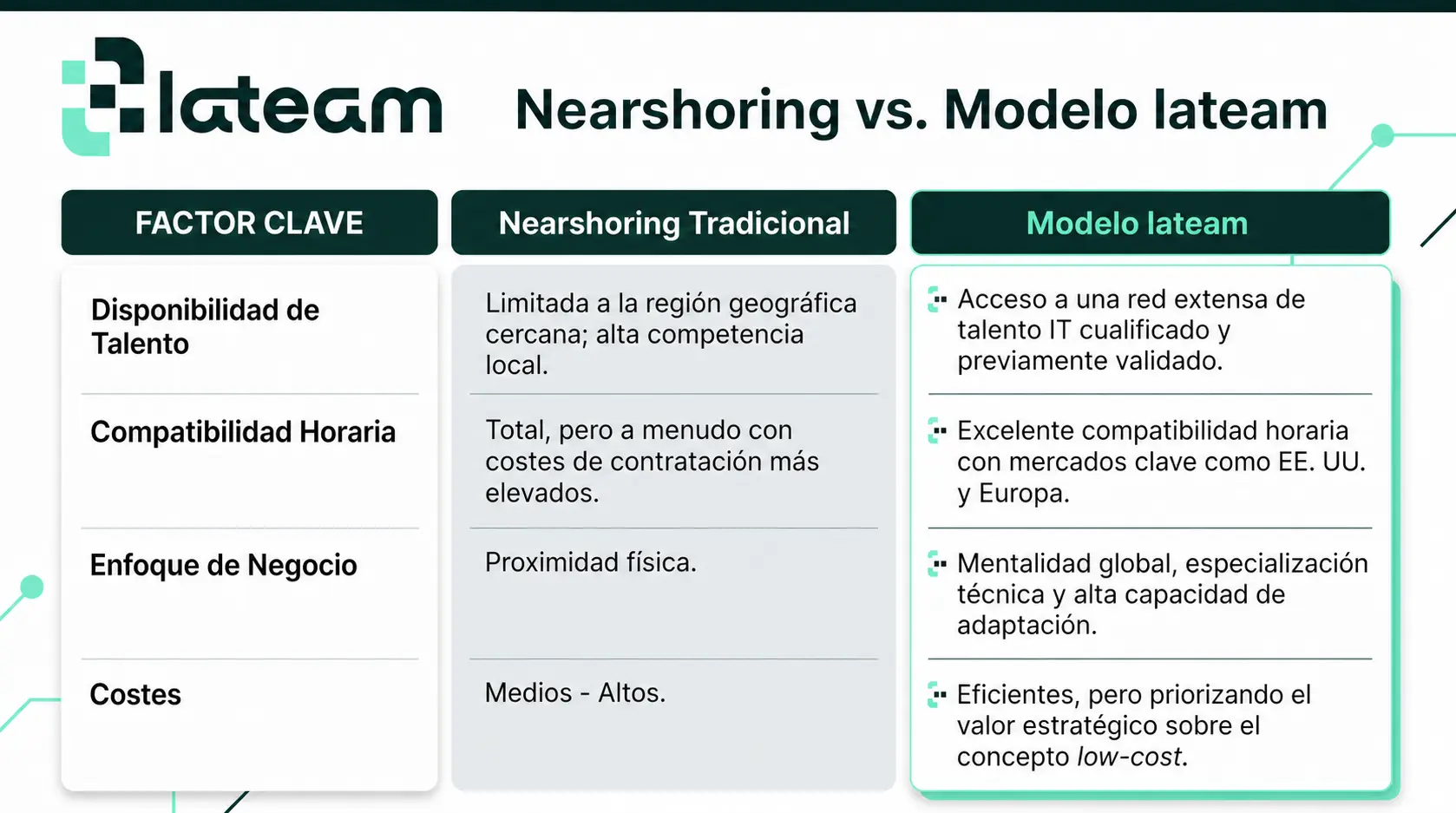
Specifically, these are the pillars of our philosophy:
People with names, not generic profiles
Commonly, both in the case of nearshoring and offshoring, one of the major problems is the lack of transparency: providers often present 'type profiles' to companies, without caring to introduce the people behind them.
At lateam, the opposite happens because we care about providing our clients with a network of previously validated talent. In it, they can see specific profiles and choose who they want to work with, so the decision to hire one person or another is always human. This allows to eliminate friction and accelerate decision-making.
Agility without intermediaries thanks to a validated network
Unlike other models, we do not rush to find talent when a request comes in. In business outsourcing, time is gold, so we already have an extensive network of previously validated IT talent. This significantly reduces hiring times, ensures a high level of quality from the very first moment, and avoids long and inefficient selection processes.
In fact, we have an AI engine that helps contracting companies verify identity, assess technical skills, and measure the fit of professionals. This analyzes the organization's needs to provide a final evaluation of each candidate based on the different levels of 'compatibility' possible.
Professional relationships designed to last
In a sector where professional turnover tends to be high naturally, business outsourcing can exacerbate this problem. Especially if approached from a purely circumstantial point of view. But at lateam, we believe that the true value lies not in filling job positions but in building solid teams.
Therefore, we work to create stable long-term relationships between our clients and the digital talent we provide. The goal is to achieve a real integration of professionals into work teams, as this improves productivity, communication, and commitment.
To achieve this, we offer:
An initial trial period of 14 days (not free) to validate the actual fit.
Free replacement of the professional if it doesn't work out.
The possibility to directly internalize talent: if the company decides to hire the person, they have full freedom to do so.
Global presence, local proximity
Although our focus is on talent from LATAM, at lateam we combine a global mindset with international presence, having offices in Cali (Colombia), Havana (Cuba), Valencia (Spain), and an operational office in the United States. This allows us to offer continuous support and follow-up from our internal teams.

Business outsourcing: the right talent makes the difference
The debate between nearshoring and offshoring has evolved. Today, the true value of business outsourcing goes beyond geographical distance and lies in the ability to access the right talent, integrate it into teams, and build lasting professional relationships. In this new scenario, models such as outsourcing from LATAM demonstrate that it is possible to combine cultural affinity, time compatibility, and technical excellence without sacrificing proximity or quality.
At lateam, we have transformed this service into an experience centered on people, transparency, and agility. Mainly because our approach allows companies to quickly scale tech teams, reduce risks, and have professionals who truly fit their culture and objectives.
Therefore, if you are looking for a new way to understand technological outsourcing, we invite you to contact us and discover the reasons why today LATAM is closer to Spain than ever.
If you liked this article, you might also be interested in: