Leading talent management in tech companies: total team control or outsourcing?

In the tech sector, there is a widely held belief: to ensure the success of projects, companies must have absolute control over their teams. This perception is widely accepted, as it considers that employees perform better and more effectively by being part of the staff and having assimilated the organizational culture.
However, in a market as demanding as the current one —where innovation directly depends on the ability to adapt, scale, and lead human teams— a debate is emerging around talent management in tech companies: does maintaining total internal control over every IT profile really add more value than relying on specialized partners that allow for greater agility and reduced operational burden?
If you want to stay informed about tech talent management, hiring and new trends, subscribe.
As the shortage of tech talent intensifies and projects demand increasingly specialized skills, many organizations are questioning this. But experience is showing them that, in most cases, the answer is not about choosing between internalizing or outsourcing, but finding the right balance between both strategies to respond more agilely to business needs.
Does the ‘in-house’ model really offer total control?
The traditional model argues that the best talent management in tech companies is one that has full control over each team member. To achieve this, it relies on direct hiring, which seemingly guarantees:
Mastery of processes and outcomes.
Optimal alignment with corporate culture.
Development of internal knowledge.
That the worker has a greater sense of belonging.
This option has worked effectively while organizations have operated in stable and predictable environments. However, as the market has accelerated its pace of transformation, its limitations have become increasingly evident. The speed at which technologies evolve and business needs change has surpassed companies' ability to attract, onboard, and develop the necessary talent.
As a result, new IT professions have emerged, such as specialists in AI, cybersecurity, cloud computing, or data engineering. Positions that are in high demand due to organizations' need to keep up, but which cannot be fully covered due to the lack of qualified talent: according to data from the Organization for Economic Cooperation and Development, there are currently more than three vacancies for every available professional in the sector.
Projects are no longer built on patience
Paradoxically, the total control promised by the ‘in-house’ model is now being questioned due to its inability to control deadlines to meet objectives. This is due to long hiring periods, which in the case of software engineers (such as developers or AI specialists) can take up to 62 days.
That is, too much time for companies that, in most cases, cannot afford to halt their strategic roadmap to complete one or several of their hiring processes. This explains why talent management in tech companies is not the real quid of the matter, but rather how it can be accessed.

Why traditional outsourcing is not the best way to delegate work?
To overcome the hurdle of slow internal recruitment, many organizations turn to traditional outsourcing. This model seemingly promises them flexibility and immediate capacity to scale, but in reality, it translates into obvious operational frustrations for tech leaders.
The problem lies in its approach, more concerned with blindly delegating work than with building aligned and highly committed teams. Mainly because:
It settles for offering generic profiles: there is no deep technical criterion behind the selection processes, as the real fit of the professional in the company and the project is not taken into account.
It activates only when necessary: traditional consultancies do not have talent networks, so when they receive a request, they must rush to the market to find the ideal profile.
It is not stimulating for the professional: being perceived as a resource solely intended to meet a specific need can diminish their motivation and, with it, their level of commitment and involvement with the project.
It tends to prioritize cost reduction over execution quality: traditionally, cost savings have been the main reason for choosing IT outsourcing; but this comes at the expense of other important factors, such as technical quality or the ability to coordinate work teams.

How to grow with external IT talent without losing control of the situation
The report ‘IT Sourcing Study 2025’ prepared by Whitelane Research in collaboration with Eraneos reveals some interesting data about the situation of tech talent in Spain:
38% of organizations plan to increase their spending on external providers.
9% expect to reduce their investment.
19% of companies consider themselves indecisive, demonstrating that many are in a moment of strategic reevaluation.
Thus, although outsourcing remains an effective solution for scaling capabilities, the trend points toward hybrid models that integrate the best of both approaches: the flexibility, speed of response, and access to specialized talent that external partners provide, along with the preservation of knowledge and the development of strategic capabilities within the organization.
In this regard, the study reveals that among organizations planning to reduce their spending on external providers, 72% do so for strategic reasons. The goal is not to eliminate external talent, but to strengthen control over the critical capabilities of the business in a context where technology plays an increasingly decisive role in competitiveness.
The hybrid proposal from lateam for talent management in tech companies
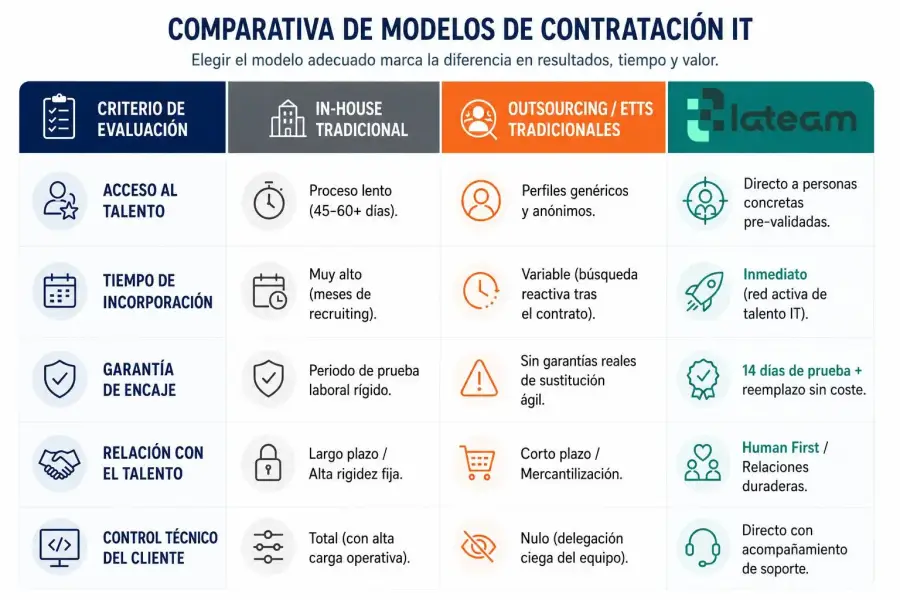
Therefore, the dilemma of talent management in tech companies does not lie in choosing between ‘black’ or ‘white’. At lateam, we propose a middle-ground solution, supported by IT outsourcing, that allows companies to maintain control over their projects and work teams at all times.
This innovative model is distinguished by:
Favoring the fit of the professional
When searching for talent, companies access real individuals, not generic profiles. Each professional has a name, surname, and a verified track record, allowing the client to evaluate the available talent and choose the one that best fits their requirements.
Helping recruiters make better decisions through a pre-validated professional network and our AI engine
At lateam, we do not start searching for professionals when we receive a request. Our competitive advantage lies in having a pre-validated IT talent network, which allows companies to identify and select, in a matter of minutes, the most suitable candidate with the support of our artificial intelligence.
In addition to verifying the identity of each professional, through this technology, the platform evaluates their technical fit and analyzes the level of competence required for each position, offering personalized recommendations based on the specific needs of each organization.
From outsourcing to insourcing in one step
Our proposal is designed to provide maximum convenience to companies looking to grow through outsourcing. Therefore, it is completely flexible:
To reduce the inherent risk of any hiring, it offers an initial trial period of 14 days (not free) that allows checking the real fit of the professional in the client's dynamics.
If the expected synergy does not occur, it allows replacing the worker at no additional cost during the aforementioned trial period.
If everything goes perfectly, the company can decide to hire the person directly. This allows them to always maintain control over their IT talent management.
Offshoring that feels like nearshoring
The digital talent network we have built is based in LATAM, so our model transforms distance into a series of operational advantages:
Time zone alignment, due to the compatibility between Latin America, Europe, and the U.S.
Cultural and linguistic affinity, as a large part of the IT workforce in LATAM has a high command of English and shares the vision and values of Western corporate culture.
Cost optimization, by offering a more economical infrastructure and lower labor costs compared to other regions of the world.
The future of talent management in tech companies lies in flexibility
Talent management in tech companies is no longer just about hiring internal profiles or outsourcing resources. The most competitive companies are those that can combine control, agility, and access to specialists when the business needs it. Thus, a hybrid model like that of lateam allows for accelerating projects, incorporating strategic knowledge, and scaling teams without sacrificing quality or alignment with the organization's objectives.
Do you need to quickly and safely incorporate qualified IT talent? Schedule a call with our team or request talent to find the professionals that best fit your tech projects.
If you liked this article, you might also be interested in: